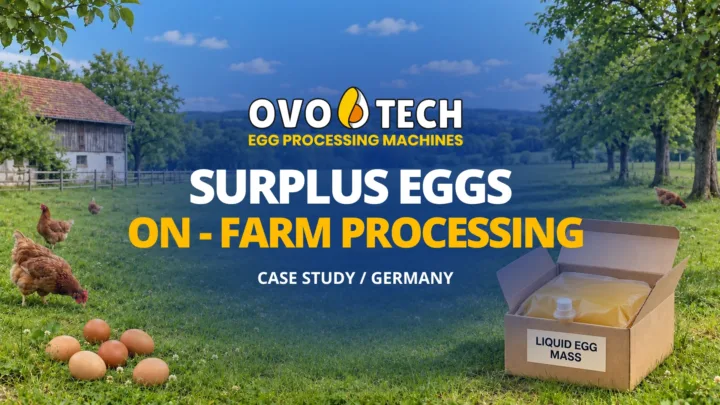
An article published in the German agricultural journal Bioland Fachmagazin (author: Andreas Greiner) details Germany’s first on-farm installation (hofeigene Produktionsanlage) for processing surplus organic eggs directly on the farm.
For laying hen farms, seasonal demand fluctuations are an ongoing operational reality: hens lay continuously year-round, while table egg consumption drops significantly in summer. As Dr. Severin Hauenstein, Managing Director of the certified organic farm Hofgut Martinsberg in Rottenburg am Neckar, stated: “Hens don’t fly to Mallorca on vacation”. Historically, the only option during surplus periods was selling shell eggs to industrial processing plants at spot rates well below production costs.
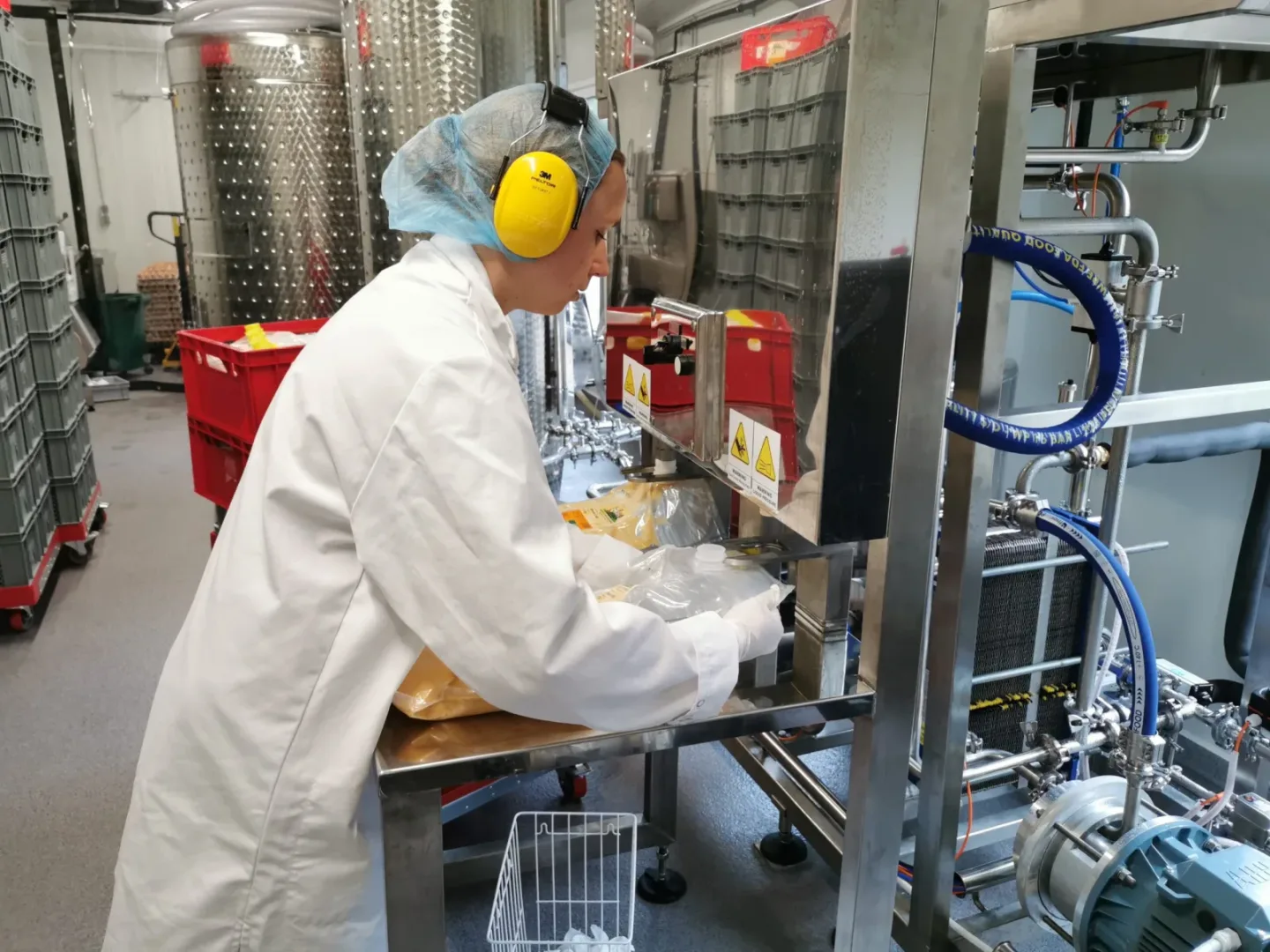
The farm invested in its own processing line combining an OVO-TECH egg breaker with a Dion Engineering pasteurization module. This established an on-farm facility for certified organic liquid egg (Bio-Flüssigei), enabling on-site surplus processing, full retention of the Bioland certification, and direct regional B2B supply to artisanal food businesses.
Implementation Parameters: Hofgut Martinsberg
| Parameter | Operational Data |
|---|---|
| Location and certification | Rottenburg am Neckar (Baden-Württemberg, Germany) |
| Process flow | Breaking (RX egg breaker with yolk-white separation) → 0.2 mm filtration → RSH pasteurization (Dion) → Cooling to 1.5°C → Bag-in-box filling (5 & 10 kg) → Freezing at -18°C |
| Shelf life | Minimum 18 months with preserved functional properties |
| Primary customers | Regional organic bakeries, confectioneries, commercial canteens |
The Solution: On-Site Processing and Extended Shelf Life
How does the farm solve the summer egg surplus?
Instead of selling surplus eggs below cost, the farm breaks, pasteurizes, and freezes them at -18°C on-site. The resulting liquid egg remains fully viable for 18 months, stabilizing product supply and providing year-round delivery to regional commercial buyers.
Supported by the European EIP-AGRI innovation program, Hofgut Martinsberg installed an on-farm plant processing approximately 20% of its own egg volume alongside eggs sourced from two Bioland partner farms. Dr. Hauenstein’s objective was not to replace table egg sales, but to capture margin on surplus inventory during seasonal troughs and turn a recurring loss into steady revenue.
Process Mechanization: OVO-TECH and Dion Engineering
For a medium-sized enterprise, the primary requirement was selecting machinery that fit within existing farm buildings and met strict veterinary hygiene standards without building an industrial hall. The integration of OVO-TECH and Dion Engineering provided the necessary operational capacity and consistency:
- Precision Breaking (RX egg breaker with yolk-white separation): The mechanical sequence replicates the gentle action of human hands, cleanly separating shell from liquid without creating micro-fragments in the egg mass. This maximizes product recovery and streamlines downstream filtration.
- Controlled Pasteurization (Dion Engineering): Continuous HTST thermal processing neutralizes microbiological pathogens while protecting native protein structures. Cooled to 1.5°C, the liquid flows directly into 5 kg and 10 kg bag-in-box packs prior to -18°C blast freezing.
- Compact Stainless Steel Design: Manufactured using food-grade acid-resistant stainless steel, the closed-circuit layout facilitates daily cleaning and CIP sanitation according to requirements from the veterinary authority in Tübingen.
B2B Application: Bakeries and Commercial Kitchens
Frozen, pasteurized organic liquid egg from Hofgut Martinsberg supplies regional commercial operations that require verified organic ingredients and lower labor overhead:
- Artisanal Bakeries: Bäckerei Berger in Reutlingen and Bäcker Baier in Herrenberg utilize the liquid egg for sponge cakes, cheesecakes, and glazes, reporting substantial preparation time savings and consistent baking results.
- Emma’s Springerle (Münsingen): The specialty pastry maker reports uniform dough texture, stable baking volume, and natural coloration with uniform product viscosity.
- Commercial Food Service (Gasthaus Lamm, Blaubeuren-Asch): Preparing 4,500 daily meals for schools and staff canteens, this facility eliminated manual breaking of 50,000–60,000 shell eggs per year by switching to bag-in-box packs.
The on-farm processing setup represents a long-term investment: it hedges against spot price drops, converts seasonal surpluses into shelf-stable inventory, and retains full product value. As Dr. Severin Hauenstein concluded: “The plant operates with high efficiency and remains fully competitive”.
For detailed planning considerations for SME on-farm processing setups, consult our guide Build Your Liquid Egg Factory: SME Processing Line.
Sources and Reference Material
- Greiner, A., Flüssigei stabilisiert den Absatz, Bioland Fachmagazin, Issue 10/2026, p. 40. Available online: bioland.de
- Hofgut Martinsberg, Bioland Flüssig-Ei aus hofeigener Produktion, EIP-AGRI project documentation. Installation photo at Hofgut Martinsberg